You Won’t Believe These Mind-Blowing Structures Near Mount Fuji
When I first laid eyes on Mount Fuji, I expected breathtaking nature—but not architectural wonders hiding in plain sight. Instead of just trails and temples, I discovered surreal designs blending tradition and innovation. From glass houses clinging to hillsides to centuries-old wooden teahouses with impossible curves, these structures redefine what a mountain journey can be. This isn’t just sightseeing; it’s stepping into a world where architecture dances with nature. Let me take you somewhere most travelers never see.
The Unexpected Face of Mount Fuji
Mount Fuji is often celebrated as a natural masterpiece, its symmetrical cone rising above forests, lakes, and rice fields like a sacred sentinel. Yet beyond its well-trodden climbing paths and iconic viewpoints lies a quieter, equally powerful narrative—one written in wood, steel, and glass. Around its base, from the misty highlands of Yamanashi to the forested slopes of Shizuoka, an unexpected architectural renaissance has taken root. These are not mere buildings; they are dialogues between human imagination and natural grandeur. While millions photograph Fuji from a distance, few pause to notice how the structures at its feet reflect the same reverence, balance, and precision that define the mountain itself.
The presence of such innovative architecture near Fuji is no accident. Japan has long embraced the principle of shakkei, or “borrowed scenery,” in garden and building design—a philosophy that integrates distant landscapes into the immediate environment. Architects working near Fuji apply this concept with modern tools, crafting spaces that frame the mountain not as a backdrop, but as a living participant in the experience. Whether through floor-to-ceiling windows, strategically angled roofs, or reflective surfaces, these designs invite Fuji into the room, making it impossible to separate the built from the natural.
Additionally, the evolution of tourism has played a crucial role. As visitors seek deeper, more immersive experiences, traditional inns and observation decks are being reimagined. Local governments and private developers alike recognize that sustainable, thoughtfully designed architecture can enhance rather than detract from the region’s beauty. The result is a growing collection of structures that honor the past while embracing the future—spaces that do not compete with Fuji but instead deepen our connection to it.
Hakone’s Glass Pyramid: A Sci-Fi Mirage in the Woods
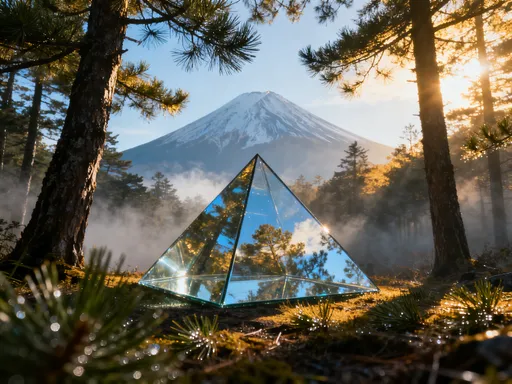
Just a short journey from the shores of Lake Ashi, nestled among cedar and maple trees, stands a structure that seems to belong to another world. The Glass Pyramid, part of the Hakone Open-Air Museum complex, rises like a crystalline mirage from the forest floor. Its geometric glass panels reflect the shifting colors of the sky and the dappled greens of the surrounding canopy, creating an ever-changing visual effect that blurs the line between building and environment. At dawn, it glows like a lantern; by midday, it nearly vanishes into the light.
Designed to harmonize with nature rather than dominate it, the pyramid serves as both an art space and an architectural statement. Inside, rotating exhibitions feature contemporary sculptures and installations, many of which explore the relationship between humanity and the natural world. The transparent walls allow visitors to experience art while remaining visually connected to the forest, reinforcing the idea that creativity and nature are not separate realms but intertwined forces. The building’s minimal footprint and use of sustainable materials further reflect its ecological ethos.
For families and travelers seeking a unique cultural experience, the Glass Pyramid offers more than just visual intrigue. It is fully accessible, with ramps and elevators accommodating all visitors. Guided tours are available in multiple languages, and the surrounding sculpture garden provides shaded walking paths, rest areas, and panoramic views of the valley. To avoid peak crowds, mid-week mornings in spring or autumn are ideal. And while the structure may appear futuristic, its spirit is deeply rooted in Japanese aesthetics—transience, simplicity, and the beauty of impermanence.
Traditional Craftsmanship Meets Modern Form: The Fuji View Hotel Renovation
Perched on a gentle rise with an unobstructed view of Mount Fuji, the Fuji View Hotel has long been a favorite among travelers seeking comfort and serenity. Originally built in the 1960s as a modest alpine lodge, it recently underwent a transformative renovation that has redefined its identity. Rather than replacing the old with the new, the architects chose to honor the hotel’s history while infusing it with contemporary design principles. The result is a space that feels both nostalgic and refreshingly modern—a place where memory and innovation coexist in quiet harmony.
The most striking change is the reimagined roofline. Where once there were flat, boxy structures, now graceful, slanted roofs echo the silhouette of Fuji itself. These angular forms are not merely decorative; they serve a functional purpose, channeling rain and snow away from the building while minimizing wind resistance. Constructed from sustainably sourced Japanese cypress, the roofs age beautifully, their warm tones deepening over time to blend with the surrounding forest.
Inside, the transformation continues. Floor-to-ceiling windows wrap around common areas and guest rooms, turning every glance toward the outside into a moment of awe. The mountain is no longer just a view—it becomes part of the living space, changing with the light, weather, and season. Interior materials were carefully selected for their natural textures: polished stone floors, handmade washi paper lamps, and tatami-mat lounges invite touch and stillness. Even the lighting is designed to mimic the soft glow of dawn, helping guests ease into the rhythm of the mountain.
The renovation also prioritized environmental sustainability. Solar panels are discreetly integrated into the roof design, and a geothermal heating system reduces reliance on fossil fuels. Rainwater is collected for landscaping, and waste is meticulously sorted and recycled. These features are not marketed as gimmicks but as essential components of respectful living in a fragile ecosystem. For the women who manage the hotel—many of whom have worked there for decades—the changes represent progress without loss of soul. “We wanted to welcome the future,” one longtime staff member shared, “without forgetting who we are.”
Hidden Teahouses with Impossible Shapes
Far from the tourist circuits, tucked into the forested foothills of Fuji, stand small wooden teahouses that seem to defy the laws of physics. Their roofs curve upward in fluid arcs, their beams interlock without a single nail, and their positions—perched on narrow ridges or nestled in clearings—suggest a deep understanding of both landscape and spirit. These are not modern experiments but living testaments to centuries-old craftsmanship, where traditional Japanese joinery techniques have been passed down through generations. Each teahouse is a quiet act of resistance against mass production, a reminder that beauty can emerge from patience, precision, and respect.
One such teahouse, accessible via a two-hour hike from the town of Fujinomiya, appears as if it were folded from a single sheet of paper. Its roof sweeps upward like a wave, supported by a lattice of interlocking wooden joints known as kanawa tsugi. These connections rely on friction and geometry rather than metal fasteners, allowing the structure to flex during earthquakes—a critical feature in this seismically active region. Inside, the space is minimal: a sunken hearth, a low table, and tatami mats worn smooth by time. Yet the effect is profound. Sitting here, with steam rising from a bowl of matcha and Fuji visible through the open veranda, one feels a rare sense of stillness.
These teahouses were never built for grandeur. They serve as places of reflection, hospitality, and seasonal celebration. In spring, families gather to view cherry blossoms; in autumn, friends share roasted sweet potatoes and stories. Some are maintained by local cooperatives, others by individual caretakers who visit weekly to sweep the floors and replenish supplies. Access is intentionally limited—there are no signs, no tickets, no official hours. Visitors are expected to arrive quietly, leave no trace, and honor the space as a gift from the community.
For those seeking them, the journey is part of the experience. Hiking trails are well-marked but not crowded, and the air grows cooler and sweeter with elevation. Along the way, wooden markers carved with poetic phrases—“Listen to the wind,” “Rest here a moment”—invite mindfulness. Reaching a teahouse feels less like arrival and more like return. These structures do not shout for attention; they wait, humble and enduring, for those willing to slow down and see.
The Chureito Pagoda: Where Iconic Views Meet Symbolic Design
Rising from a hillside cemetery in the town of Fujiyoshida, the Chureito Pagoda is one of the most photographed structures in Japan. Its five tiered roofs, painted in a vibrant red-orange, ascend a stone staircase of 398 steps, culminating in a perfect alignment with Mount Fuji on clear days. Especially during cherry blossom season, when the trees along the path burst into soft pink bloom, the scene becomes a living postcard—a harmonious blend of human symbolism and natural beauty that captures the essence of Japanese aesthetics.
Originally built in 1963 as a memorial to soldiers who died in World War II, the pagoda stands as a symbol of peace and remembrance. Its location was carefully chosen not only for the view but for its spiritual significance. In Japanese tradition, pagodas are often associated with Buddhist temples and serve as reliquaries or places of contemplation. The Chureito Pagoda, though not part of an active temple, carries this meditative quality. Visitors climb the steps not just for the photograph, but as a form of quiet pilgrimage—a physical ascent that mirrors an inner journey.
The design follows classical Japanese pagoda architecture, with each tier slightly smaller than the one below, creating a sense of upward movement and lightness. The wooden structure is supported by a central pillar that extends deep into the ground, symbolizing stability and connection to the earth. Unlike modern buildings that seek to dominate the skyline, the pagoda complements its surroundings, its height modest, its colors vivid yet natural.
For travelers, visiting the pagoda requires planning. Early morning is the best time to avoid crowds and capture the mountain in soft, golden light. Weekdays during late March or early April offer the best chance to see the cherry blossoms without the crush of weekend visitors. Comfortable walking shoes are essential, as the climb is steep. Once at the top, benches provide rest, and a small shrine nearby allows for quiet reflection. This is not a place to rush through, but to inhabit, even briefly, with gratitude and presence.
Modern Art Meets Mountain Spirit: The Narusawa Ice Cave and Beyond
The Narusawa Ice Cave, one of several lava tubes formed by ancient eruptions of Mount Fuji, has long drawn visitors with its year-round frost and otherworldly blue ice. But in recent years, the experience has been enhanced by thoughtful architectural interventions that elevate the natural wonder without overshadowing it. The visitor center, designed with clean lines and natural materials, blends into the forest edge, its cedar walls weathering to a soft gray over time. Inside, interactive displays explain the geology of the region, the formation of ice caves, and the importance of preserving these fragile environments.
From the center, a gently sloping pathway leads to the cave entrance. Unlike older constructions that used harsh lighting and metal railings, the current design employs soft, integrated LED strips embedded in the walkway, minimizing glare and energy use. Handrails are made from sustainably harvested bamboo, their smooth curves echoing the organic shapes of the cave walls. These details reflect a growing philosophy in Japanese design: that infrastructure should serve the landscape, not control it.
Adjacent to the cave, small art installations dot the forest floor—sculptures made from volcanic rock, wind-activated chimes, and woven fiber pieces that change with the seasons. These works, created by local artists, respond to the environment rather than impose upon it. One installation, a spiral of stone and moss, aligns with the sun during the winter solstice, casting a shadow that points directly to Fuji. Another, a series of suspended glass panels, captures the sound of falling leaves, transforming it into a subtle melody.
The entire site operates on a reservation system to limit daily visitors, ensuring minimal impact on the delicate ice formations. Guided tours emphasize respect and silence, encouraging guests to listen to the drip of melting water and the whisper of wind through the trees. For mothers and daughters, friends, or solo travelers, the experience is both educational and deeply moving—a reminder that nature, when treated with care, offers its greatest gifts freely.
Why These Structures Matter: The Future of Mountain Architecture
The buildings around Mount Fuji are more than aesthetic achievements; they represent a philosophy of coexistence. In an era of climate change, overtourism, and rapid urbanization, how we build in sensitive natural areas matters more than ever. The structures near Fuji offer a model: architecture that listens before it speaks, that enhances rather than consumes, that honors both heritage and innovation. They remind us that human creativity, at its best, does not conquer nature but converses with it.
Sustainability is at the heart of this movement. From solar-powered hotels to handcrafted teahouses built without nails, the emphasis is on longevity, low impact, and respect for materials. Communities are increasingly involved in design decisions, ensuring that new developments reflect local values rather than outside interests. In some villages, residents vote on proposed projects, and architects are required to spend time living in the area before beginning work. This slow, participatory approach stands in contrast to top-down development models seen elsewhere.
Internationally, Japanese mountain architecture is gaining recognition for its balance of form and function. Design schools in Europe and North America now study Fuji-adjacent projects as case studies in sustainable tourism and cultural preservation. Yet the most important audience may be the everyday traveler—especially women who plan family trips, seek meaningful experiences, and value spaces that feel safe, beautiful, and authentic. These structures offer not just shelter or scenery, but a sense of belonging.
As you plan your next journey, consider looking beyond the summit. The true magic of Mount Fuji lies not only in its peak but in the quiet spaces around it—where a glass pyramid reflects the forest, a teahouse waits on a ridge, and a pagoda stands in silent conversation with the sky. These are not just places to visit, but invitations to see differently, to build gently, and to live with greater awareness. Let Fuji inspire not just your camera, but your heart.